Ads Hook Testing: Build a First-3-Seconds Test Pack First


A lot of ad teams burn their time on the wrong creative. The visuals can be clean, the product can look good, the editing can feel current, and none of it matters if the first three seconds do not hold anyone. When the opening fails, everything after it is just paying down the cost of a bad start. The fix is to filter earlier. Instead of building a full ad and then betting that the hook lands, build a hook test pack first and let the opening prove itself before you commit to the rest.
The Hook Is the Whole Decision
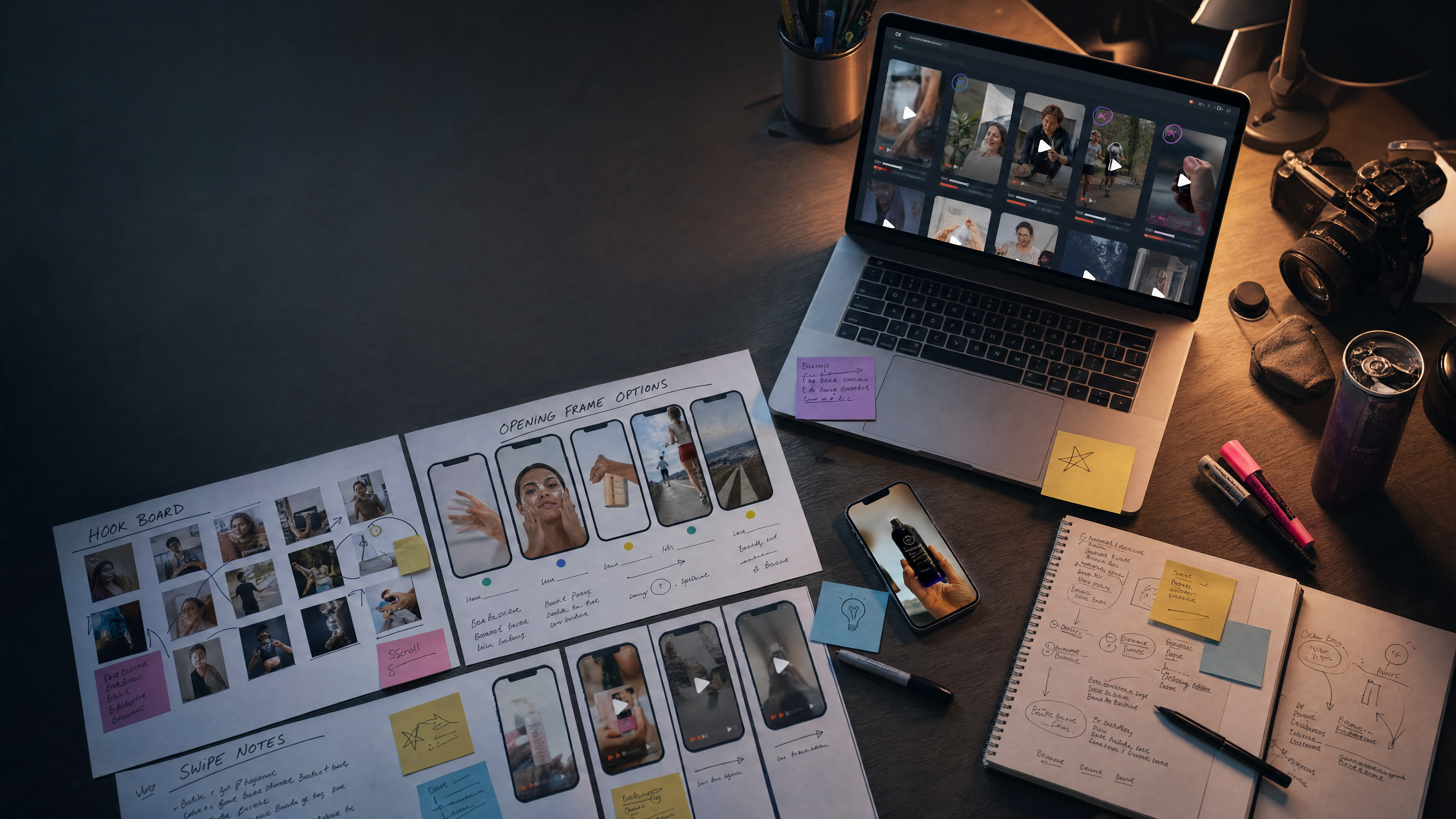
Too many paid-social workflows treat the opening beat as something to sort out later, in the edit. It works the other way around. The first three seconds are where you decide whether someone can instantly read the category, whether the pacing feels native to the platform, whether the product enters too early or too late, and whether the emotional promise is strong enough to buy the next second of attention. When that decision is weak, the whole ad usually is too.
Start With the First Three Seconds
The fastest way to move quicker is not to produce more finished cuts. It is to test more openings: more first frames and more first actions. Start with three to five hook directions, each answering a different attention question:
- Product interrupts first
- A problem creates tension first
- The change appears first
- The creator's reaction enters first
- Texture sparks curiosity first Swapping the color palette and calling it a new test does not count. Each direction should be going after a genuinely different reason to stop.
Six Hook Formulas to Steal
Most strong openings come from a handful of repeatable formulas. Use these as your starting directions, then write a specific version for your own product:
| Hook formula | Best for | What the opening does |
|---|---|---|
| Product interruption | Beauty, gadgets, physical products | The product enters hard on the first frame, before any setup |
| Problem-first | Supplements, fitness, anything that fixes something | Opens on the exact frustration, before the product appears |
| Reveal / before-after | Skincare, cleaning, hair, transformations | Starts mid-change so the result is already in motion |
| Creator reaction | UGC, apps, food, services | A real face reacts before a single word of explanation |
| Texture / sensory | Food, drinks, beauty | Extreme macro of a pour, texture, or finish before any context |
| Pattern interrupt | Broad, scroll-heavy feeds | An unexpected visual or sound that does not read as an ad |
Each one answers a different reason to stop, which is exactly why a test pack should pull from several formulas at once rather than five versions of the same idea.
Test Stills and Video Side by Side
A hook test pack only works if it covers both static logic and motion logic, because some hooks are won by composition and others are won by timing. A still can prove whether the product silhouette is strong enough on its own, a short looping clip can prove whether the reveal actually feels satisfying, and a caption-free reaction shot can prove whether a real face on camera earns trust. You want all three working before you decide which idea deserves a full build.
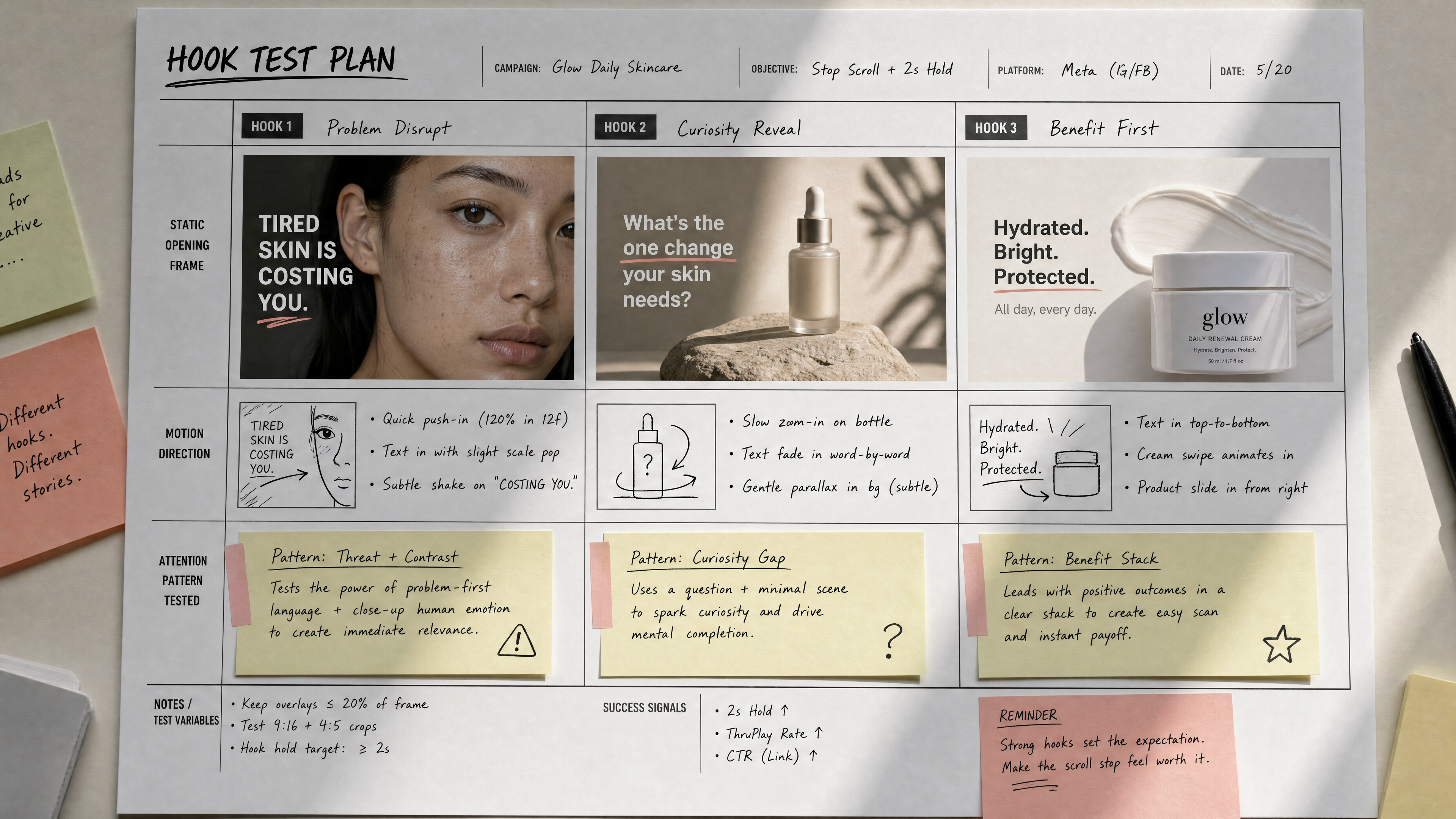
This is where Thank You AI fits naturally: you can test several opening frames first, then extend only the winning hook into short video versions, instead of rebuilding the whole ad from scratch.
Want to test hooks across image and video in one place? Test ad hooks faster with 100 free credits →
One Hook, One Job
The most common weakness in a test is that every variant tries to do everything at once. A stronger system gives each hook a single job:
- Stop the scroll
- Spark curiosity
- Establish product value fast
- Create visual contrast
- Make the next line of copy, or the next shot, feel earned This is also why the prompts get noticeably better. The brief stops being "make an ad video" and becomes something like "a curiosity hook for a skincare texture reveal" or "a problem-led opening for a fitness creator's product."
Five Questions Before You Scale
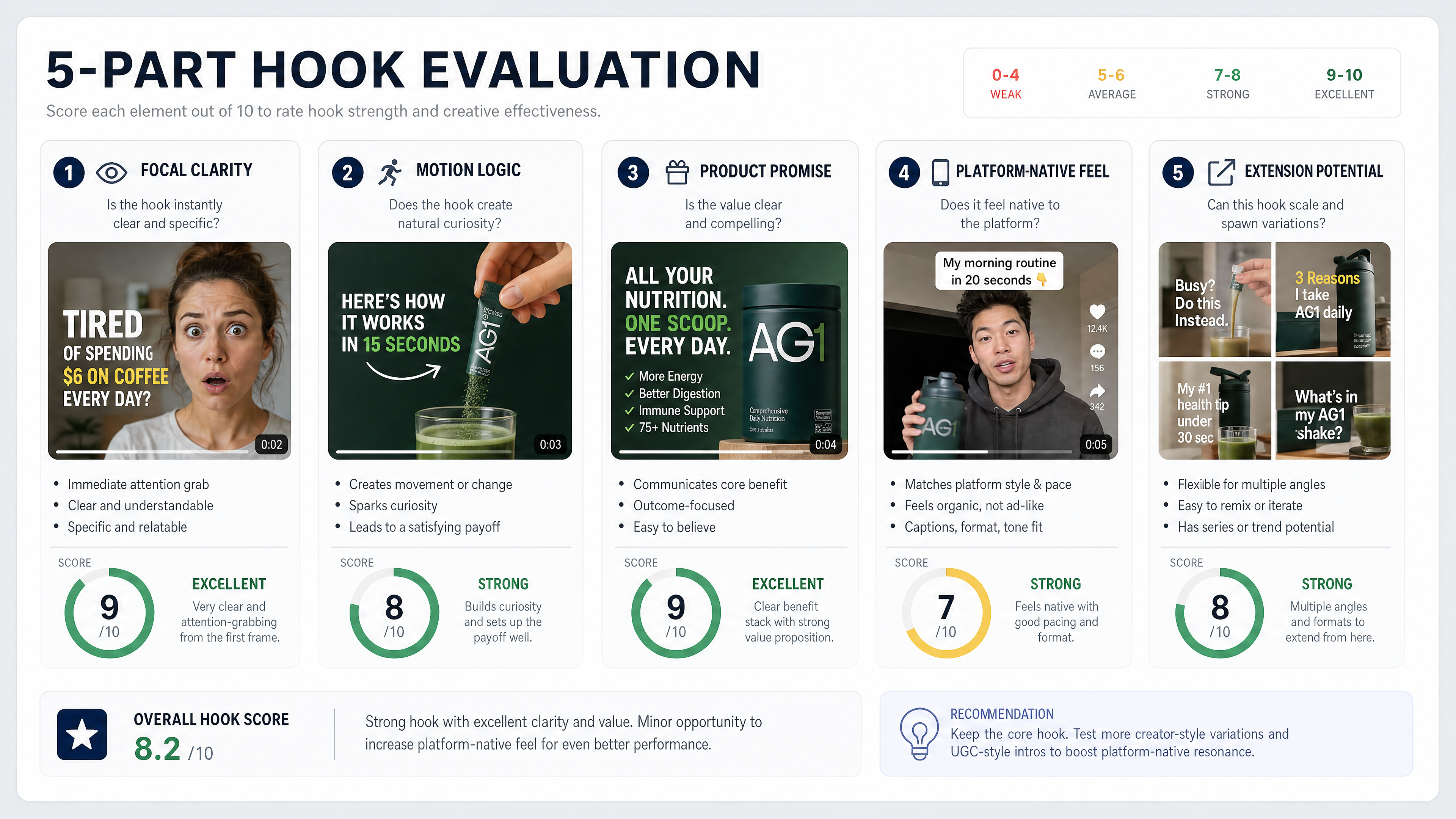
Before you expand a hook into a full ad, put it through five questions:
- Can someone read the focus in under a second?
- Does the action still make sense with the sound off?
- Is the product promise visible before the viewer has to work for it?
- Does this look more like native platform content than an over-polished ad?
- Can this opening lead naturally into the next three shots? Running this check avoids a frequent mistake: picking the best-looking hook instead of the one that is best to build on.
Build a Ladder From the Winner
Once an opening wins, resist the urge to jump straight to a single final ad. Build a ladder out of it instead:
- The winning hook as a cover still
- The winning hook as a 3-second clip
- The winning hook extended into a 6-second cut
- The winning hook adapted to 9:16 and 1:1
- The winning hook re-paced through the middle as a second variant You get more output from the same creative logic, and your testing stays efficient.
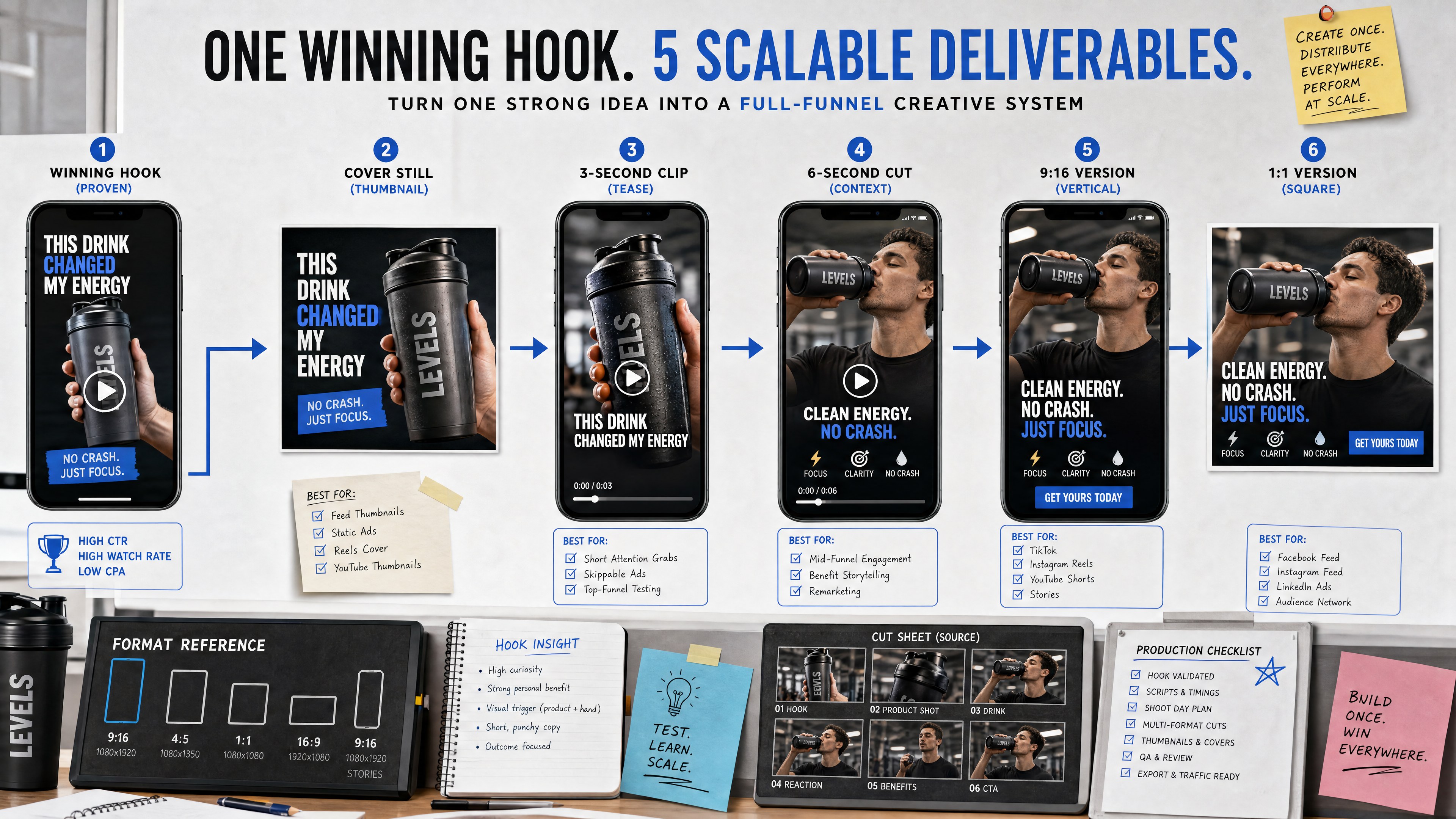
Ready to spin one winner into a full set? Turn one ad idea into faster hooks and variations →
Specs for Every Platform
A hook only works if it survives the format it runs in. Before you scale, match the aspect ratio and keep the key element clear of the platform's interface:
| Placement | Aspect ratio | First-three-second priority |
|---|---|---|
| TikTok | 9:16 | Hook in the very first frame; keep text clear of the bottom UI strip |
| Instagram Reels | 9:16 | Same vertical frame; leave room at the bottom for caption and CTA overlays |
| YouTube Shorts | 9:16 | Make the first frame strong enough to double as the thumbnail |
| Instagram feed | 4:5 or 1:1 | 4:5 takes up more vertical space in feed, so the hook reads larger |
| YouTube in-stream | 16:9 | Skippable after five seconds, so front-load the promise immediately |
Designing the hook for the placement, rather than the other way around, keeps a winning opening from falling apart the moment it goes live.
Describe the Interruption
The best ad-hook prompts are not product descriptions. They describe why the shot interrupts someone. So instead of:
beautiful product ad in modern lighting
write something closer to:
macro opening on a cluttered makeup bag, a hand darts into frame, and a clean-looking bottle catches the one highlight in the shot; the camera holds for half a beat before the reveal
That second version actually tells the model why the shot might stop a thumb.
8 Hook Prompts You Can Copy
These are written as three-second openings, each built around an interruption rather than a product description. Swap in your own product and category.
Hook 1 — Product interruption
extreme close-up on a plain surface, a hand snaps a sleek product into frame on a hard cut, the product catching the only sharp highlight in the shot, half-beat hold before the first move
Hook 2 — Problem-first
tight shot on the exact moment of frustration before any product appears, natural light, a real reaction, then a fast cut on the beat where the viewer expects relief
Hook 3 — Reveal / before-after
open mid-transformation so the change is already happening on the first frame, one continuous move from the rough state to the clean result, no titles, caption-free
Hook 4 — Creator reaction
a real face reacting first, looking just off-lens, a genuine micro-expression before a single word, handheld feel, phone-camera realism rather than studio polish
Hook 5 — Texture / sensory
extreme macro of a pour or texture filling the whole frame, slow enough to feel tactile, the product silhouette arriving only after the texture has already hooked the eye
Hook 6 — Pattern interrupt
an unexpected object or motion that does not look like an ad, an off-rhythm first second, the visual landing before the viewer can categorize it as branded content
Hook 7 — Unboxing anticipation
hands entering a cluttered everyday surface, one clean product half-revealed at the edge of frame, the camera withholding the full reveal for a beat to build curiosity
Hook 8 — Proof / demonstration
the product doing the one thing it promises, shown in a single uncut action, real surfaces and honest lighting, the result visible before any explanation is needed
The Real Win Is the System
A mature ad team does not stop at which ad won. The more useful question is which kind of opening is worth ten more tests. That is the real payoff of a hook test pack: it turns a single guess into a reusable system of stills, short videos, variant cuts, and platform-ready creative. The sooner you know which three seconds are worth expanding, the less time you waste on full ads that never had a chance to win. Once your winning hooks are feeding a steady stream of variants, the next step is to run them inside a repeatable system, which is exactly what we cover in our guide to building an AI ad creative engine.
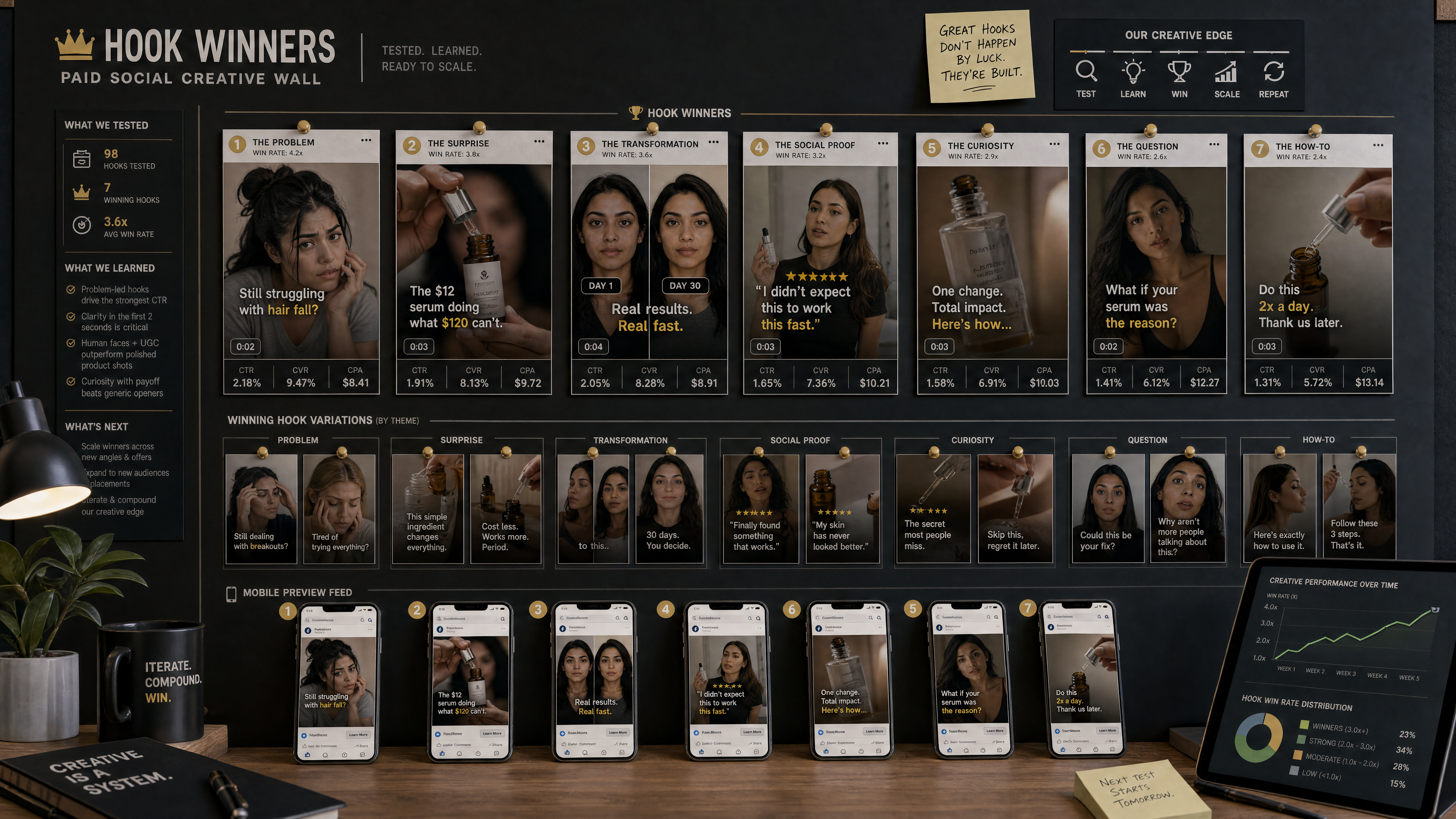
Build paid-social creative packs without rebuilding every asset by hand. Start testing ad hooks with Thank You AI →
よくある質問
Frank is a growth-focused operations and marketing professional with expertise in product data engineering. He specializes in turning user insights into scalable growth strategies. At THANKYOU AI, he leads operations, marketing, and growth efforts, leveraging data to shape product decisions and connect innovation with the audiences that need it most.